Critical Praise for
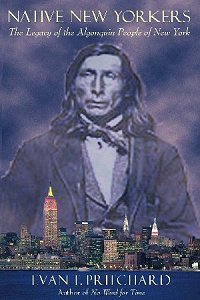
Native New Yorkers: The Legacy of the Algonquin
People of New York
by Evan T. Pritchard
Council Oak Books 1-57178-107-2
Algonquin "canoe commuters" used to
dock in the same place where a local railway station now links
New York City and Hoboken, NJ Brooklyn's main thoroughfares, Flatbush
Avenue and Kings Highway, were major trade routes of the Canarsie
people. With nuggets like these, Pritchard (No Word for Time),
a Marist College Native American history professor and founder
of the Center for Algonquin Culture, conveys the extent to which
Native American civilizations have shaped the geography of modern
New York.
Divided into three sections covering New York City, the Hudson
Valley and Long Island, the book is a tour of Indian landmarks
and historical sites, with descriptions of the cultures, history,
languages and lore of the Native American inhabitants. Drawing
on archival material as well as interviews with present-day leaders
of the Algonquin nations, Pritchard offers a wealth of information
that doesn't make it into many New York City histories or guidebooks…
New York history buffs and those interested in the Native American
past will welcome Pritchard's attempt to fill in the gaps.
Publishers Weekly, April 29, 2002
Native New Yorkers is a trove of information on
the Native Algonquin peoples of New York City and New York State.
With a wry, humanistic sensibility, Pritchard synthesizes historical
and ethnological materials from a wide array of sources, many
of which are buried in hard-to-find academic works. The book is
further distinguished by his own experiential perspectives as
a person of Micmac descent who has conducted ethnographic research
with Algonquin elders across the United States. With an open,
accessible style, this is a highly readable introduction to the
Native American cultural history of New York York City and beyond.
It should find interested audiences in a broad variety of educational
contexts, from the high school level upward. Anyone with an interest
in the Native history and culture of New York will find much
to absorb her in this work.
Peter M. Whiteley, Curator, Division of Anthropology,
American Museum of Natural History
One of the greatest compliments our people can
give is to say that someone is a good listener. Indeed, listening
is the first stop a true storyteller must master. Native New Yorkers
proves that Evan Pritchard is a very good listener indeed. I suspect
that many American Indians will feel as I do, that this is a book
we've been wanting for many generations. Every New Yorker should
read it.
Joseph Bruchac, Abenaki storyteller
author of Lasting Echoes and Sacajawea
Evan Pritchard, a Micmac scholar, has produced
a miracle: a scholarly, informative book that is fun to read and
full of surprises.
Pete Seeger
Native Oral tradition, supported by archeological
evidence, tells us that Long Island used to be the hub of many
great nations, with the Algonquin at the center. Yet when asked
about these first "New Yorkers," many hesitate. Were
they assimilated? Did they die of white man's diseases? Are their
descendants anywhere to be found? (Yes to all of these questions.)
Drawing from a variety of historical and anthropological documents,
Pritchard, whose Micmac heritage is cousin to the New York Algonquin,
exhibits a consummate sense of the underlying story that brings
a once-vanquished people to fresh life. He portrays a complex
culture from many perspectives; horticultural practices, lodge-building,
canoe-crafting, and herbal medical lore interweave with the political
and ceremonial side of Algonquin life both past and present. Though
the author does not pretend to offer a complete picture of the
civilization, each chapter furthers an appreciation of the largely
unacknowledged but significant Algonquin presence in New York
(state and city) and throughout North America.
NAPRA Review, May/June 2002
Evan Pritchard's new book is an excellent read,
extremely well researched and a treasure for any library - personal,
private or public. Not only is it the most detailed report of
the Algonquin nation in New York, but it is done in a manner that
all interested people can relate to.
Dark Rain Thom,
author of The Shawnee: Kohkumthena's Grandchildren
The significance of Evan Pritchard's book, Native
New Yorkers, can truly be realized in the aftermath of 9/11, for
this book brings to early light, the powerful reminder to New
Yorkers and all Americans, that history repeats itself for a country
that doesn't learn it. Evan Pritchard takes us back in time when
only the Native American people thrived on these shores, living
lives in socially stable and ecologically balanced environments.
He takes us back to colonial invasion, and to the first colonies
of the Dutch, and to the first historical echoes of terrorism.
Like those scientists and astronomers studying the cosmos based
on information supplied by great telescopes traveling through
space, Pritchard delves into the history of America's past.
To share this history with us, he uses documented European and
transplant American records, journals, and accounts, and does
not neglect to respectfully include the wisdom and knowledge contained
within the oral and written literatures of the Algonquin Peoples.
Native New Yorkers is a culmination of scholarly insights and
information about one of the most well-known places in the world,
and results in keeping the true history of America alive for another
generation,
an invaluable history that may have otherwise been lost. Thank
you.
Gabriel Horn, MA, Professor of writing and literature,
author of The Book of Ceremonies; Contemplations of a Primal
Mind
and Native Heart - An American Indian Odyssey
A tremendous, first-rate volume, Native New Yorkers
is a timely must-have for educators, students, researchers and
enthusiasts alike. Pritchard has opened a whole new chapter in
Native American Studies, which is sure to generate invigorating
dialogue on the subject.
Roberto Mucaro Borrero (Taino), Public Programs Coordinator,
American Museum of Natural History
I write to rave about this terrific new book which
opens new doors, closes old ones, adds flavor to a visit to Manhattan,
raises questions, and answers many of mine. I have read it once,
but
am reading and marking passages for reference now. Truly, there
is no book like it out there.
Beth Herr, Curator, Trailside Lenape Museum,
Ward Pound Ridge, Katonah, N.Y.
This incredibly detailed and imaginatively presented
survey of life in New York City before the Europeans arrived tutors
us in the spiritual practice of truly cherishing the place where
we live. Evan Pritchard skillfully takes us beyond the contemporary
pursuits of wealth and power in Manhattan to ponder the ecological
legacies of the original Native New Yorkers - the Lenape Indians.
While reading this remarkable book, we felt closer than ever to
the heartbeat of our city, its rich multicultural heritage, and
the piece of Earth on which we live.
Frederic and Mary Ann Brussat,
co-authors of Spiritual Literacy and Spiritual Rx
Professor Pritchard beckons you to join him on
a remarkable journey that follows the paths of the Algonquin people
of New York. In the stops along the way, you will learn the language
and stories and feel the presence of the Lenape men and women
who walked the lands from present-day New York City to the domain
of the Mohicans halfway up the Hudson River. By the time you have
finished this passage through time and space, names and places
that you have taken for granted will have new meaning, and you
will look upon the 80,000 Native American New Yorkers with new
respect and understanding.
Dr. James M. Johnson, Executive Director,
Hudson River Valley Institute at Marist College
Native New Yorkers is a masterpiece of Native
American scholarship laced with personal spiritual insights. As
an Algonquin, I am deeply moved by this great and beautiful book.
Using an enormous variety of media and techniques, Evan has produced
a work of national historical importance. Evan places the Native
worldview within the context of today's consumerist society and
pop culture. Evan Pritchard, a scholar and a multi talented artist,
illuminates the Rocky Island Manahatta with the radiant light
of his spirit vision, honoring Natives, ancestors, and all the
generations to come with his Heart Song. For Evan, as for all
Algonquins, time does not exist and the land is alive with the
voices of our ancestors. This book is a landmark for our Algonquin
Nation.
Phoebe Songbundle Legére (Penobscot/Micmac),
Native Ethnomusicologist, Native Educator, Pulitzer Prize (Music)
Nominee 2001,
NYCA Award winning author of "The Queen of New England,"
an opera celebrating the life of Queen Weetamoo, Chief of the
Pocasset Wampanoag
Pritchard's Native New Yorkers is the most significant
contribution to the linguistics of Mid-Hudson First Peoples since
E.M. Ruttenber's Indian Tribes of Hudson's River (1872). It deserves
a place on any bookshelf belonging to anyone wishing to be considered
a true local historian of the Hudson River Valley. A must-read!
Melvin Johnson, Historic Site Assistant,
Washington's Headquarters State Historic Site, Newburgh NY
An author of Micmac descent who is currently professor
of Native American history at Marist College (Poughkeepsie, NY),
Pritchard has produced what is ostensibly a scholarly monograph
on the history and culture of the Algonquin peoples of New York,
though much of the emphasis is on the Munsee peoples who inhabited
present-day New York City, Long Island and the Hudson River Valley.
Though it is presented with a scholarly apparatus, it will best
serve as either a guidebook or history for lay readers… Obviously,
valuable modern oral traditions have been extensively used in
the construction of this work, but even they require some level
of corroboration for descriptions of places that haven't existed
for centuries. Recommended for public libraries in New York and
contiguous states.
Library Journal, April 15, 2002
Review by John Burch, Campbellsville University Library, Kentucky
Publisher: Council Oak Books (800) 247-8850
Related title:
No Word for Time: The Way of the Algonquin People
by Evan T. Pritchard © 2001
Council Oak Books
1-57178-103-X